
Based on our workshop recorded on April 25, 2024
Google Ads Account Structure for B2B SaaS: Consolidate or Split?
If your Google Ads account structure is wrong, Smart Bidding can end up learning from the wrong data.
That means underbidding on valuable searches, overspending on weaker traffic, and wasting already limited B2B conversion data.
For B2B SaaS, structure is not just account hygiene. It directly affects how Google groups performance data and how confidently it can bid.
The principle is simple: consolidate where possible, split when there is a clear reason, and make sure the data grouped together is relevant enough to help Google make bidding decisions.
Why Google Ads account structure matters for B2B SaaS
B2B SaaS Google Ads accounts often have limited conversion data to work with. You might get a handful of qualified leads or customers each month, not hundreds. That makes account structure more important.
Google Smart Bidding learns from performance data at different levels, including the account, campaign, ad group, keyword, and search term level. If there is not enough data at the most granular level, broader campaign- or ad-group-level performance can have more influence.
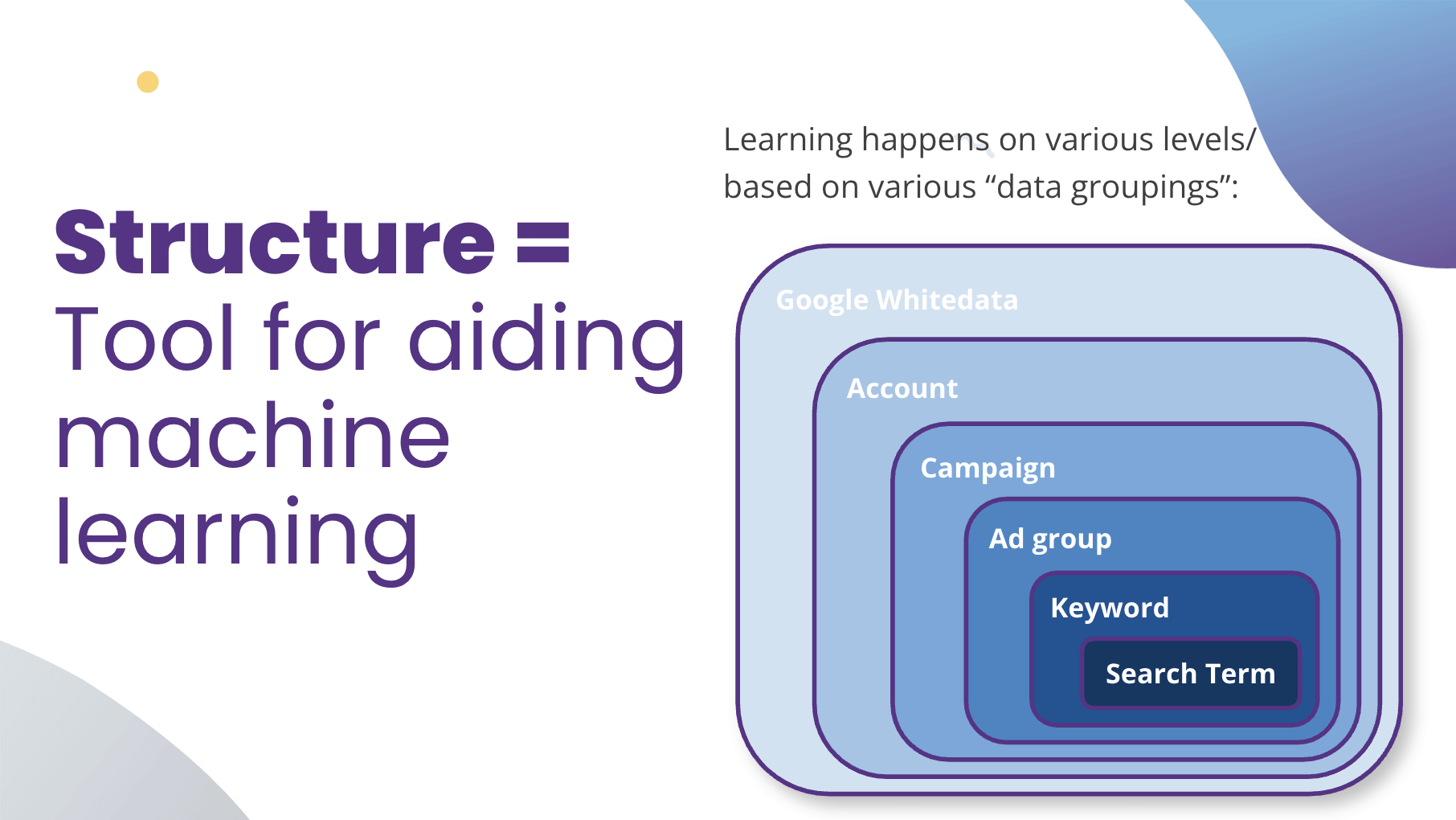
Your account structure should therefore group searches, keywords, and audiences that are similar enough for that broader performance data to remain useful.
Split things too far and you dilute already limited conversion data. Consolidate unrelated search intent, products, or buyer profiles and Smart Bidding may use broader performance patterns that do not fit the individual search.
A good B2B SaaS account structure gives Google enough relevant data to make better bidding decisions while keeping campaigns, ad groups, keywords, and search terms meaningfully grouped.
How Smart Bidding uses your Google Ads account structure
B2B accounts often do not generate enough conversions for Google to make every bidding decision from highly specific keyword- or search-term-level performance.
That makes the way you group data more important.
Google learns at different levels of the account
From broadest to most granular, the main structural levels are:
- Google-wide data
- Account
- Campaign
- Ad group
- Keyword
- Search term
Audience signals also play a role, but campaigns, ad groups, keywords, and search terms are the main structural levels you control.
Ideally, Google would have enough relevant data around every search to make a very specific bidding decision. In B2B accounts, that is often not the case.
Why relevant data groupings matter
When there is not enough data at the search-term or keyword level, broader campaign- or ad-group-level performance can have more influence on the bid.
That works better when the searches inside those groups behave similarly.
Take a campaign that mixes high-intent and lower-intent keywords. Their expected performance can be very different. High-intent searches may justify a higher bid, while lower-intent searches may deserve less.
If Smart Bidding has to lean more heavily on performance from the combined group, you can end up underbidding on valuable searches and overspending on weaker traffic.
The problem is the grouping. Smart Bidding becomes less useful when it has to draw signals from searches that behave too differently.
Why more granularity is not always better
The opposite problem is splitting the account too far.
A highly granular structure can leave campaigns, ad groups, and keywords with very little data. That makes it harder for Smart Bidding to learn from the most relevant level.
The aim is to keep enough data together for machine learning while making sure each grouping still represents searches that are meaningfully related.
When to consolidate vs. split campaigns
Too many campaigns can fragment already limited B2B conversion data.
Split campaigns when there is a meaningful difference in targeting, budget, goals, intent, audience, or measurement that requires separate control.
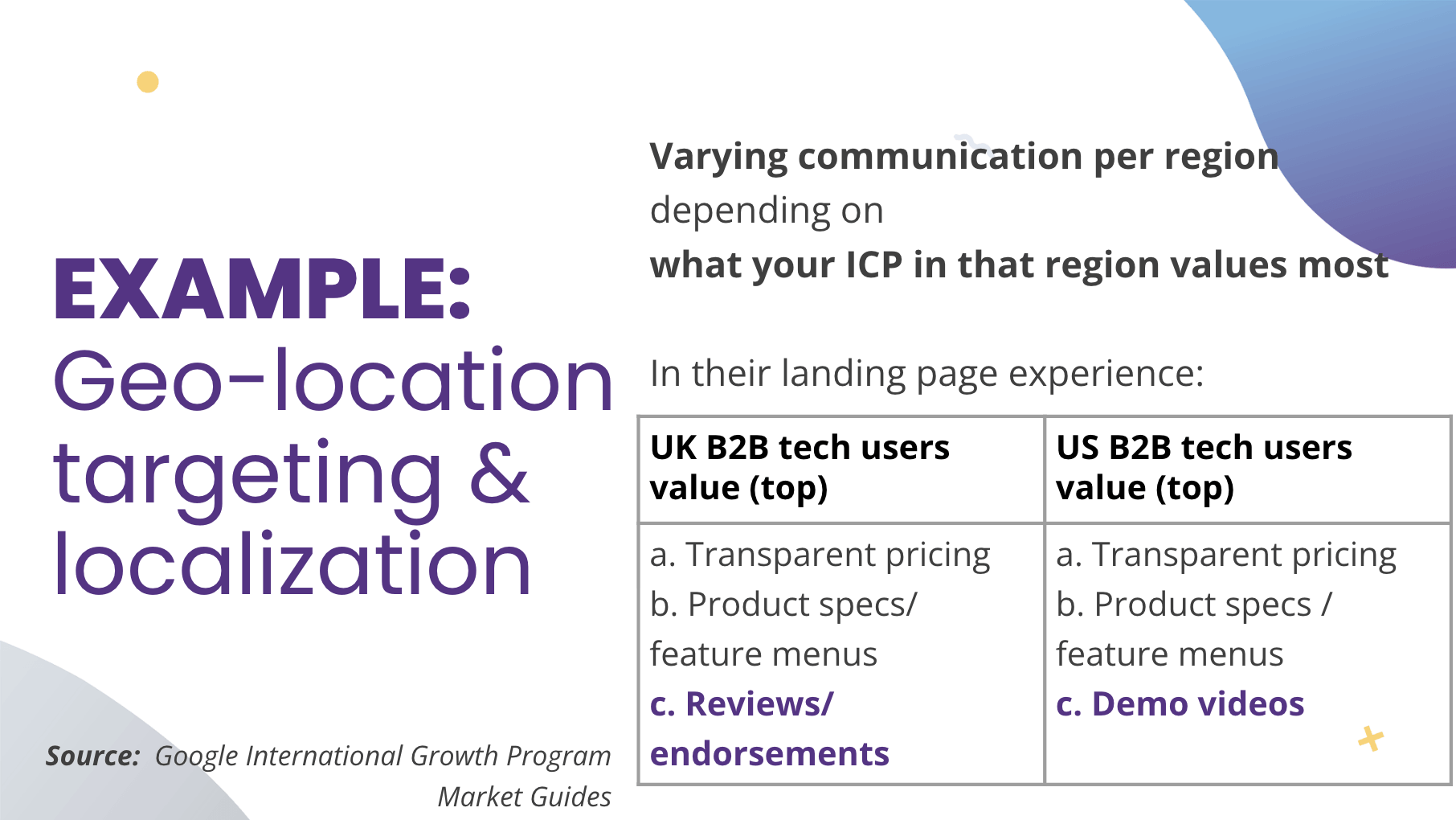
Geography, localization, and regional budgets
Separate campaigns by geography when markets need different languages, messaging, landing pages, or budgets.
It can also make sense when one region is more valuable, has its own sales budget, or needs independent investment control.
You do not need one campaign per country. If several markets have similar buyer profiles, goals, and messaging, keeping them together can preserve more useful data.
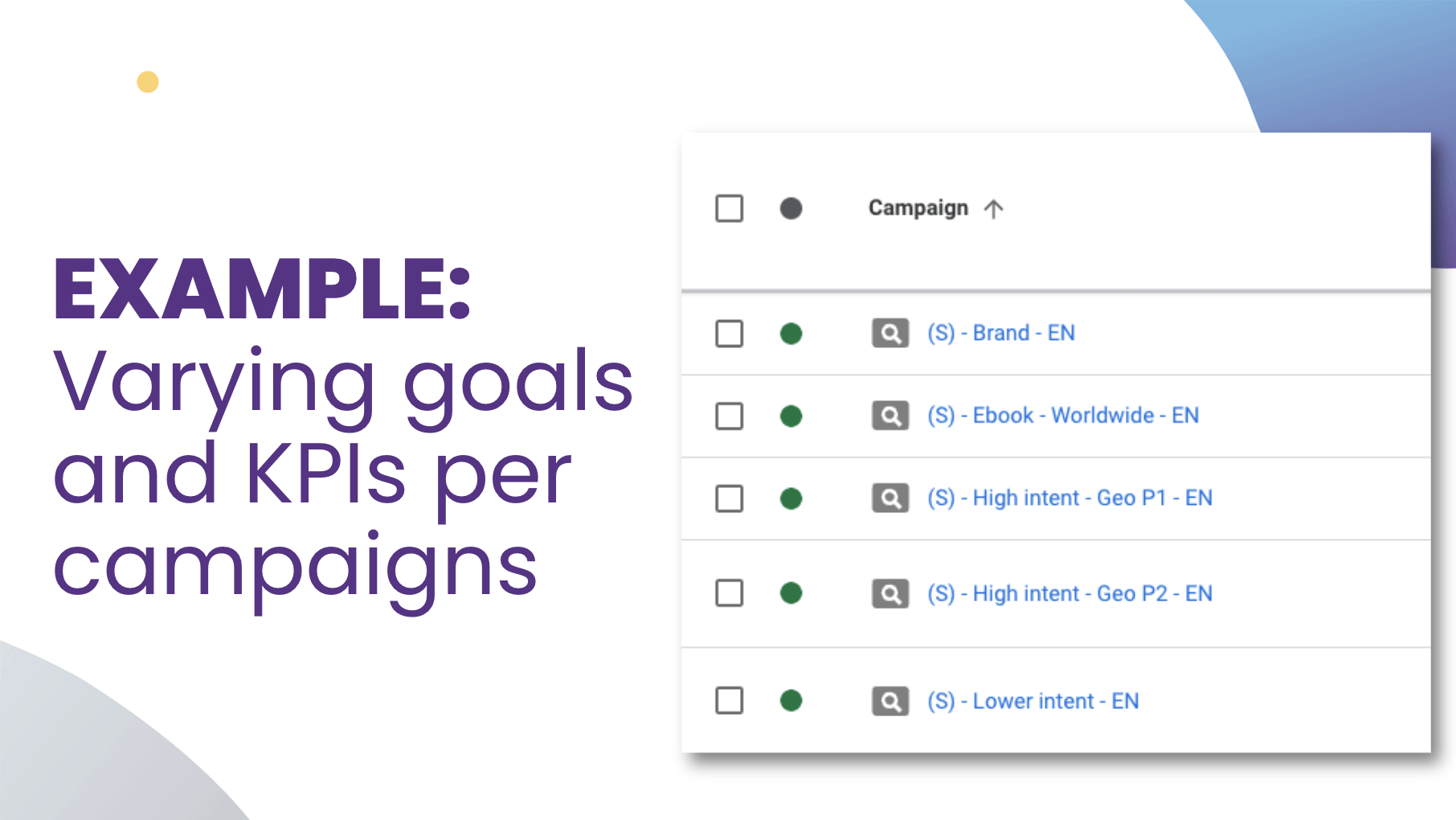
Different goals, KPIs, and search intent
Split campaigns when goals or expected performance are meaningfully different.
Brand, lead generation, content promotion, and high- or low-intent search may need different bidding targets and success criteria.
Brand campaigns are the clearest example. High- and low-intent keywords can also be worth separating if combining them would produce a performance baseline that is not useful for either group.
Different products, services, and audiences
Separate campaigns when products or services serve clearly different needs or audiences.
This makes it easier to tailor messaging, control budgets, and measure performance by offering. It can also create more coherent data groupings for Smart Bidding.
Always-on vs. burst campaigns
Always-on and short-term burst campaigns can justify separate structures when their lifetime, budget, or optimization needs differ.
Reporting matters too, but it should not be the only reason to split campaigns. If two campaigns have the same audience, goal, bidding logic, and messaging, separating them just for cleaner reporting can create unnecessary fragmentation.
Practical signs a campaign may need to be split
Keeping everything together can eventually start to hurt control, relevance, or performance.
Signs worth investigating include:
- One ad group is consuming most of the campaign budget.
- Keywords inside the same campaign show very different performance.
- Regional differences are having a clear impact on spend or conversions.
- You need separate budget control for a weaker or higher-priority part of the campaign.
- A specific audience segment needs different messaging.
These are not automatic reasons to create a new campaign. They are signals that the current grouping may no longer be useful.
A split should solve a specific problem, such as budget control, message relevance, or the usefulness of the data Smart Bidding is learning from.
How to structure ad groups and keywords in a consolidated account
The same logic applies below the campaign level.
Ad groups and keywords should preserve enough data while remaining closely related in intent, audience, and messaging.
Group keywords by intent, theme, and buyer profile
Do not group keywords together simply because they can use the same landing page.
Keywords in the same ad group may still represent different search intent or different customer profiles, even when the company’s general value proposition is the same.
A useful ad group contains keywords that are close enough in intent that the same ad can make sense for all of them. Google also uses the collection of keywords in an ad group to understand the overall intent behind that group.
There is no ideal number of keywords per ad group
There is no fixed maximum number of keywords you should aim for.
The better test is whether the keywords still belong to the same theme. If you have several relevant synonyms or closely related searches, there is no reason to split them simply to keep the keyword count low.
At the same time, adding every search variation as its own keyword can spread data across too many individual keywords.
Keep enough consolidation to preserve useful data without making the grouping irrelevant.
Add proven search terms as keywords without automatically creating new campaigns
Moving search terms that had already converted through Broad Match into separate Exact Match campaigns was a legacy approach from the Single Keyword Ad Group era.
We do not treat a converted search term as an automatic reason to create a new campaign or ad group. When conversion tracking is reliable and Smart Bidding is optimizing toward the right goals, Broad Match remains part of the core strategy.
A proven search term can still be added as a keyword where it logically fits based on intent and account structure, but the conversion itself is not a reason to split the account further.
Check old negative keywords when consolidating
Legacy account structures can create hidden problems when you simplify them.
Older, highly granular accounts often used ad-group-level negative keywords to prevent similar keywords from matching across different ad groups.
If you later consolidate those keywords but leave the old negatives in place, they can block impressions you expected the consolidated keywords to pick up.
When consolidating an older Google Ads account, review ad-group negatives, campaign negatives, and negative keyword lists alongside the keywords you are removing or moving.
Common Google Ads account structure mistakes
A bad account structure usually creates one of two problems. You either split the data too far, or you group things together that behave differently.
Both make it harder for Smart Bidding to use relevant data when deciding how much to bid.
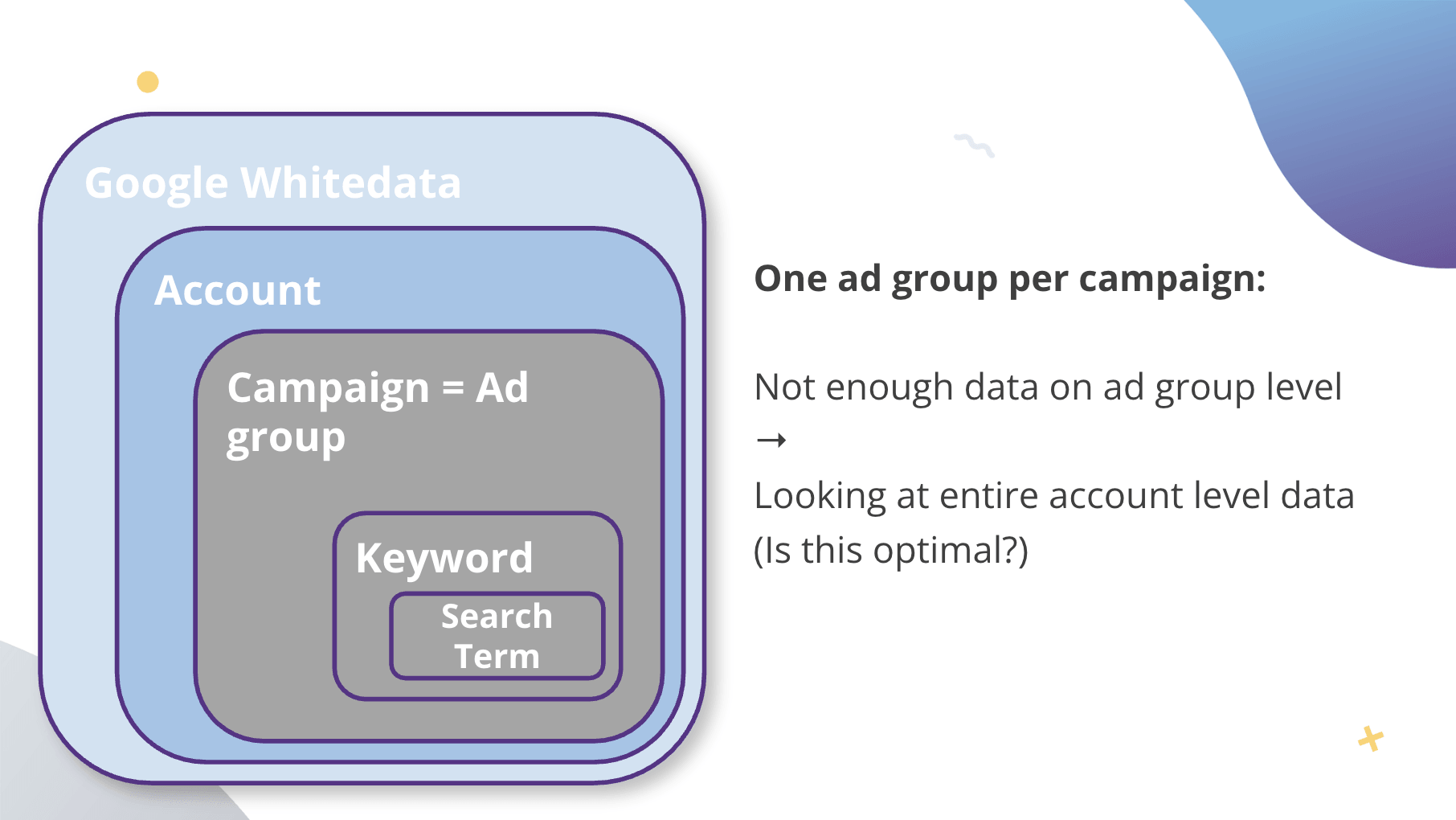
One ad group per campaign
One ad group per campaign removes one useful layer of data grouping.
If Google does not have enough data at the search term, keyword, or ad group level, campaign-level data would normally be the next place to look.
When the campaign contains only one ad group, the campaign and ad group effectively contain the same data. Google may then have to rely more heavily on broader account-level performance.
That can be a big drop in relevance.
Grouping keywords with different intent
Consolidation only works when the keywords grouped together are similar enough.
If high-intent and low-intent keywords sit in the same campaign, their average performance can become a poor basis for bidding.
High-intent searches may deserve a higher bid, while lower-intent searches may deserve less. Combining them can leave you underbidding on valuable traffic and overspending on weaker traffic.
The same applies at ad group level. If keywords represent different problems, audiences, or intent, one ad is unlikely to be equally relevant to all of them.
Over-segmenting with SKAG-style structures
The opposite mistake is splitting everything into Single Keyword Ad Groups.
SKAGs were designed to maximize ad relevance by matching one keyword closely with one ad. In a B2B account with limited conversion data, that level of segmentation can spread your data across too many campaigns, ad groups, keywords, and ads.
Use a more consolidated structure built around intent, goals, audiences, or themes instead.
Consolidation does not mean putting unrelated keywords together. It means avoiding unnecessary splits while keeping each grouping useful for Smart Bidding.
Poor keyword grouping can also hurt ad relevance. If one ad has to cover searches with materially different intent, it becomes harder for that ad to match each search closely.
That can lead to:
Lower ad relevance → lower CTR → lower Quality Score → higher CPCs → wasted budget.
Structure the account so that the data Google uses for bidding remains relevant to the search it is trying to value.
How to keep ad relevance in a consolidated structure
A more consolidated account does not have to mean less relevant ads.
Three tools can keep messaging and landing pages specific without splitting every keyword into its own ad group.
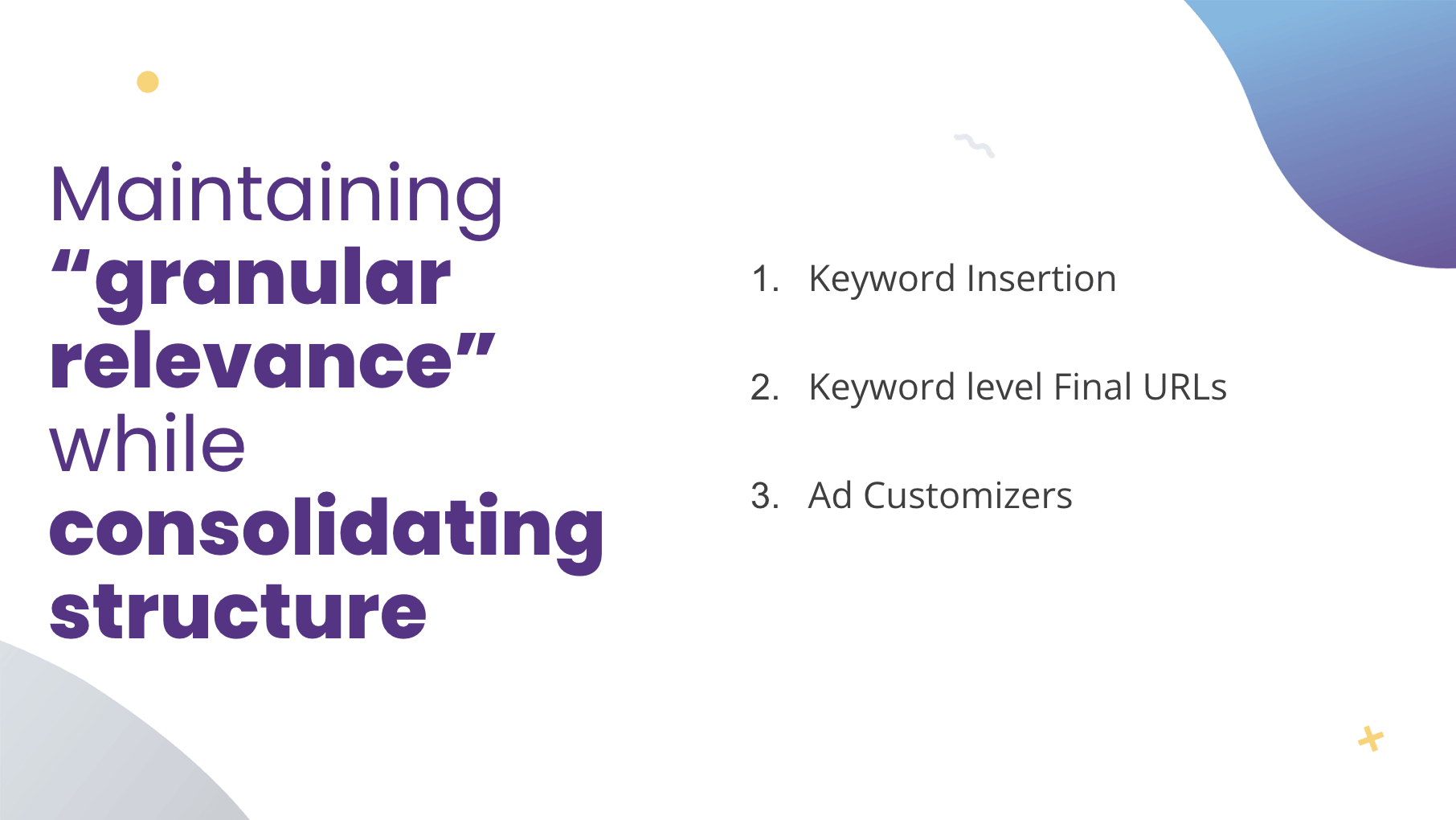
Keyword insertion
Keyword insertion lets you dynamically change part of the ad based on the keyword that triggered it.
This gives you more specific headlines while keeping multiple related keywords inside the same ad group.
You preserve the consolidated structure without giving up keyword-level variation in the ad.
Keyword-level final URLs
You can also keep keywords in the same ad group while sending them to different landing pages.
This is useful when the keywords belong together from an intent or data perspective, but one keyword would perform better with a different landing page.
You keep one consolidated ad group while matching the destination page more closely to the search.
Ad customizers
Ad customizers give you more control when inserting the keyword into the headline is not enough.
You can change specific parts of the ad based on the keyword that triggers it.
This lets you communicate more relevant benefits, features, or details while keeping a smaller number of ads and a more consolidated structure.
Frequently Asked Questions About Google Ads Account Structure
These are some of the practical questions that come up most often when structuring B2B Google Ads accounts, especially around Smart Bidding, keyword grouping, campaign consolidation, and limited conversion data.
How many conversions does Smart Bidding need?
There is no fixed threshold.
Google has communicated roughly 30 conversions per month at campaign or bid-strategy level as a useful reference point. Here, bid-strategy level means the level at which the bidding strategy is applied rather than an individual keyword.
It is not a hard cutoff. Smart Bidding does not suddenly start working at conversion number 30.
The more relevant data Google has, the more information it has to use when making bidding decisions.
How many keywords should you have per ad group?
There is no fixed maximum.
What matters more is whether the keywords share a closely related intent or theme.
If the keywords belong together and the same ad can make sense for all of them, there is no need to split them just to keep the keyword count low.
When should separate campaigns share a portfolio bid strategy?
A portfolio bid strategy can make sense when separate campaigns have the same overarching goal.
For example, two campaigns may stay separate for budget control while sharing a portfolio bid strategy because they are optimizing toward the same target.
Shared budgets and portfolio bid strategies solve different problems. A shared budget controls how budget is distributed. A portfolio bid strategy applies the same bidding strategy across the campaigns using it.
What should you do when a campaign has too little conversion data?
Consider adding higher-funnel conversion actions that provide Google with more useful signals than clicks alone.
You can also assign different values to those actions and use value-based bidding.
This gives Google more frequent signals while still giving greater weight to more valuable outcomes, such as paying customers.
Final Thoughts and Key Takeaways
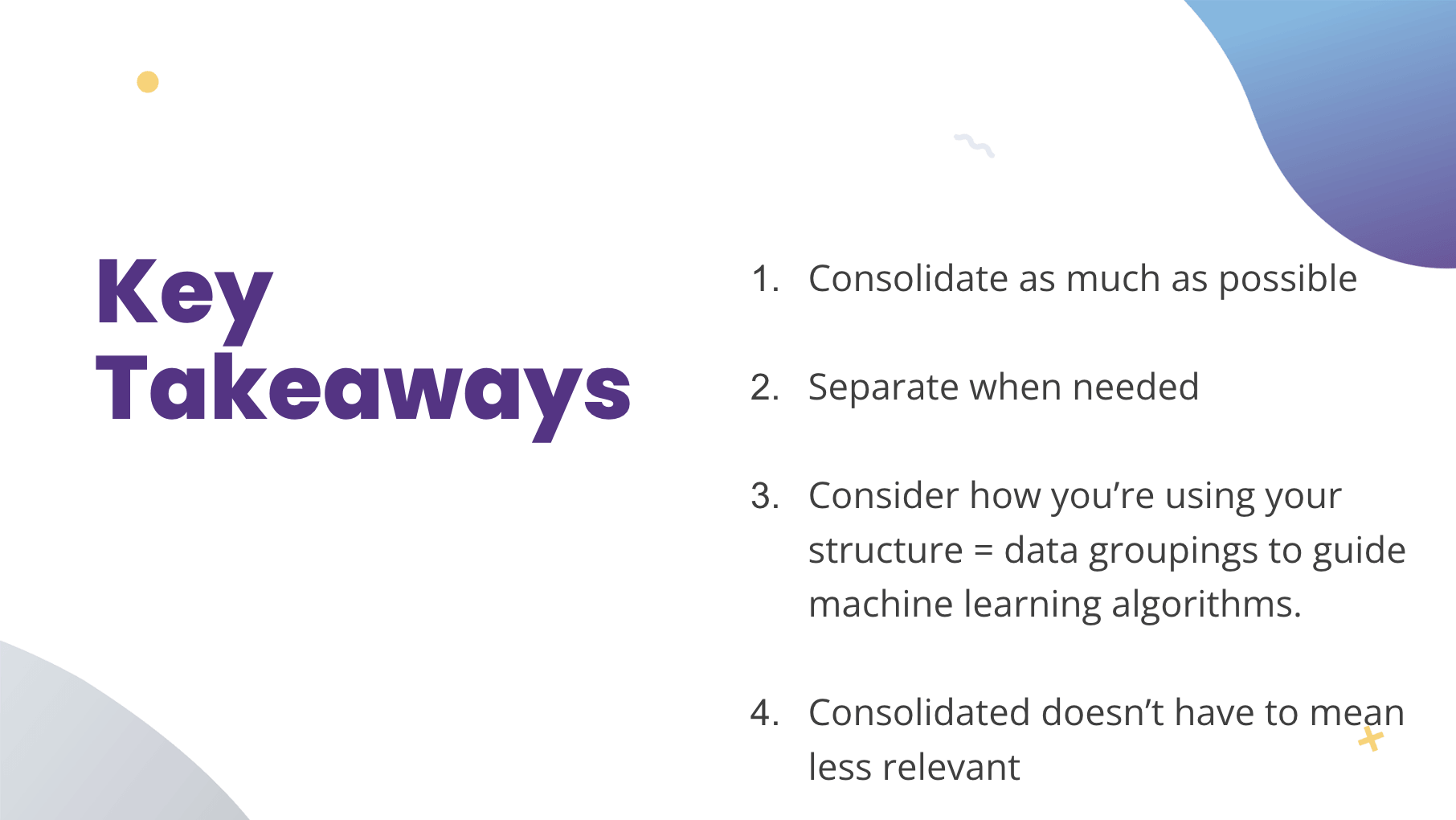
A good B2B Google Ads account structure gives Smart Bidding enough relevant data to work with.
Keep campaigns together when their goals, audiences, intent, messaging, and bidding logic are similar. Split them when a meaningful difference requires separate control or would make the combined data less useful.
Consolidation also does not have to reduce ad relevance. Keyword insertion, keyword-level final URLs, and ad customizers can keep ads and landing pages specific without fragmenting the account structure.
The target is not a particular number of campaigns or keywords. It is an account where the data available to Smart Bidding remains relevant to the search Google is trying to value.
Any questions or ready to take the next step?
Reach out early and Andres will answer your questions. We accept a limited number of new partnerships each quarter to maintain our service quality.
